Marketing attribution is how you find out which of your marketing actually produced customers and revenue, so you can put more money into what works and stop paying for what doesn’t. Most small businesses think they have it because their CRM has a “lead source” field. They don’t. That field tells you where someone came from once. It can’t tell you what made them buy.
In May I wrote about how to know if your marketing is actually working. This post picks up the question that one left open: once you accept that the platforms are grading their own homework, where does the real answer come from?
What is marketing attribution in plain English?
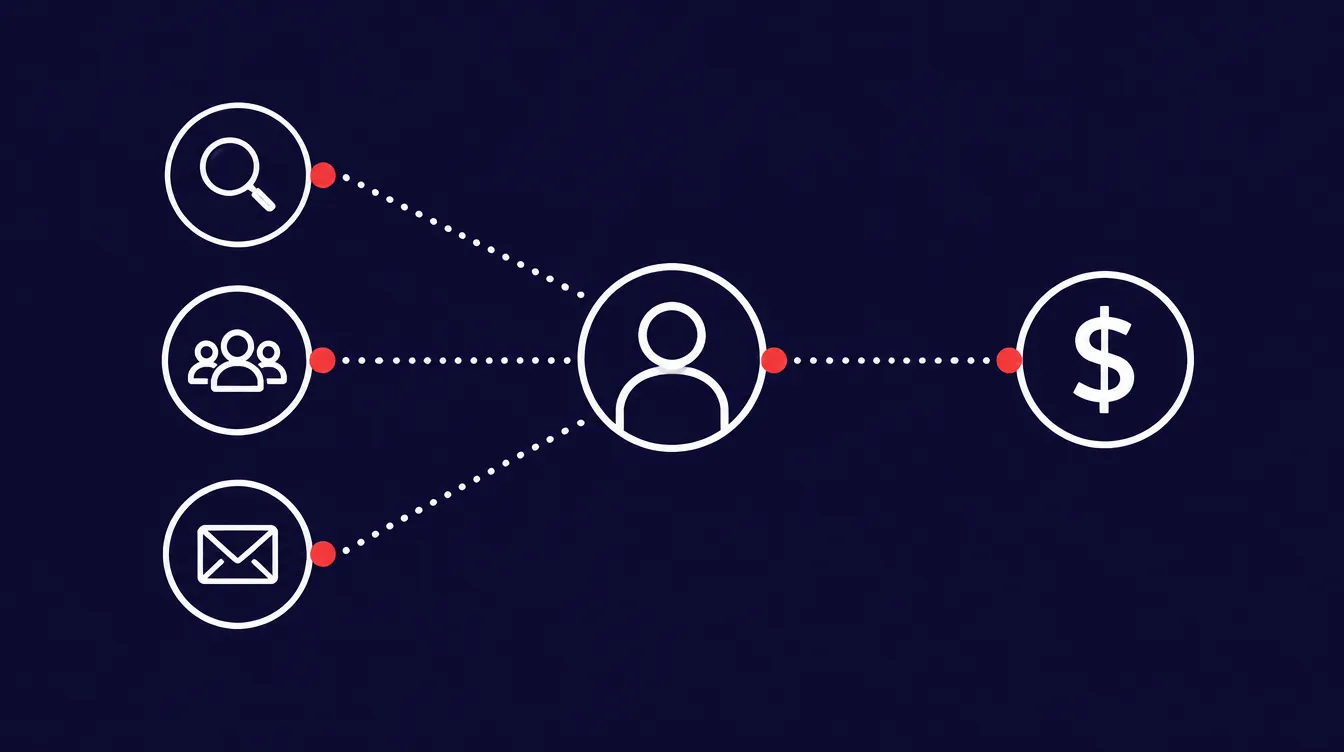
Attribution is giving credit for a sale to the marketing that earned it. Someone sees your Facebook ad, searches your name a week later, reads two blog posts, and books a call from your newsletter. Attribution is the system that records that path and decides how much of the sale each step gets.
The word sounds technical. The question behind it is simple and personal: if I cut this channel tomorrow, would I lose customers? Without attribution, you’re guessing. With it, you can scale what works and cut what doesn’t.
What types of questions can marketing attribution answer?
Good attribution answers the questions you’d actually ask in a budget meeting:
- Which channels bring in customers, not just leads?
- Which campaigns bring in the customers who spend the most?
- How long does it take someone to go from first visit to purchase?
- Which pages or emails show up in the path before people buy?
- What does it cost us to get a customer from each channel?
If your current setup can only tell you which channel sent the most form fills, it’s answering a smaller question than the one you care about. Leads are a cost. Customers are the result.
Can my CRM do marketing attribution?
Not on its own, and not with the lead source field most CRMs offer. Most setups are built for marketing, not for measurement. The common approach is to grab the tracking codes from the link someone clicked (the UTM parameters and ad click IDs), drop them into hidden form fields, and store “first touch” and “last touch” on the contact record. It looks like attribution. In practice it has three problems.
First, it only captures the visit where the form was filled out, plus maybe one earlier visit. Everything in between is lost. Second, nobody reports on it. The data sits on individual contact records, and pulling it into anything useful means exports and spreadsheets that nobody has time to maintain. Third, it breaks quietly. A form gets rebuilt, a hidden field gets dropped, and months of source data go missing before anyone notices.
Source data locked in a CRM that nobody reports on is close to useless. That’s not a knock on CRMs. They’re built to manage relationships, not to analyse journeys.
What is multi-touch attribution, and how do the models differ?
Multi-touch attribution spreads the credit for a sale across every step that led to it, instead of giving it all to one. It’s easiest to understand next to the single-touch models it’s compared with. All of them are just rules for who gets credit:
- First-touch: all the credit goes to the first thing that brought the person in.
- Last-touch (last-click): all the credit goes to the final step before they converted.
- Linear: every step gets an equal share.
- Data-driven: a model looks at which steps show up in paths that convert and weights them accordingly.
If you use Google Analytics 4, you only have two of these now. Google removed the first-click, linear, time-decay and position-based models from Google Analytics 4 and Google Ads in late 2023. What’s left is data-driven attribution and last-click.
In our systems we use last-touch, on purpose. We record each step of the sales cycle as its own event (a form fill, a booked call, a proposal, a sale), and last-touch tells us what led to each next step. That gives a clear answer at every stage of the journey, instead of one blended score at the end.
For most small businesses, the model matters less than people think. The bigger problem is usually that the conversion isn’t being recorded correctly in the first place, or that it’s recorded without any way to connect it to a real customer. Fix that first. Arguing about models on top of broken data is rearranging furniture in a house with no floor.
How does attribution work when someone buys on a later visit?
There are three different situations, and they need different handling:
- They buy on your site on their first visit. Analytics records the purchase with the revenue and the source. No CRM needed.
- They come back later and buy on your site. Analytics still records it, with the full path across visits from the same browser. Again, no CRM needed.
- They buy offline. A phone call, a signed proposal, an invoice paid two months after the first meeting. This is where most attribution falls apart, and it’s the case most service businesses live in.
The first two are mostly a setup question. The third is a system design question.
Can marketing attribution track offline and online conversions?
Yes, but only if you build for it. You map the sales cycle, then fire the sale when it happens and tie it back to the person.
Here’s how we implement it for clients. When someone fills out a form, the CRM creates a contact with its own ID. We pass that ID to the thank-you page and capture it in Google Analytics as a custom field. It’s an anonymous number, never a name or email address, because Google’s rules prohibit sending personal information to Analytics. Now the analytics record of that visitor and the CRM record of that contact share a key.
When the deal closes weeks later, the CRM sends the sale back to Google Analytics using that same key, through Google’s Measurement Protocol (the official way to send offline conversions into Analytics). The sale lands on the original visitor’s journey. Say it’s a $12,000 contract: you can now see it started with a blog post and a search ad, even though the money changed hands in an email thread.
This is the piece most setups skip, and it’s the piece that turns “we get leads from LinkedIn” into “here’s what a LinkedIn customer is worth compared to a Google one.”
Where should attribution reporting live?
In your analytics, and for anything serious, in a data warehouse fed by your analytics. Not in the CRM.
Google Analytics 4 can export its raw data to Google BigQuery, Google’s data warehouse. The export is available on the free version of Analytics, with a limit of one million events per day, which is far more than most small business sites produce. You pay for BigQuery storage and queries once you go past the free sandbox limits. Once the data is there, you can join it with sales data and build reports that answer the budget-meeting questions above.
The CRM’s job is to run the relationship and report the sale. The analytics system’s job is to know where that sale came from. Keeping those jobs separate is what makes the answer trustworthy.
What are the best marketing attribution tools for small businesses?
For most small businesses, the best tools are the free ones you already have: Google Analytics 4, connected properly to your CRM, with the raw data exported to BigQuery when you need deeper reporting. There are good paid attribution platforms, but they cost real money every month. Before you buy one, ask whether your conversions are being recorded accurately in the free tools you already have. In our experience, most aren’t, and software layered on top of broken tracking just gives you more confident wrong answers.
You also may not need any of this if you run one or two channels, sell mostly from referrals, or close a handful of deals a month that you can trace by asking the customer. Ask “how did you hear about us?” on every call and write it down. That’s attribution, and for a small enough business it’s enough.
You do need a proper system when you’re spending real money across several channels, your sales cycle runs longer than a few weeks, or you can’t answer “what does a customer from this channel cost us?” without a long silence.
The bottom line
Marketing attribution tells you which marketing produced customers and revenue. A lead source field in a CRM can’t do that, because it captures one moment and nobody reports on it. Record conversions properly in your analytics, connect each lead to an anonymous contact ID, send offline sales back to that ID, and do the reporting where the journey data lives.
If you’d like to know what your current setup can and can’t tell you, that’s what our Measurement Marketing work starts with. Book a 30-minute call and we’ll look at it together.
Sources: Google, “Measurement Protocol (Google Analytics 4)” developer documentation. Google Analytics Help, “BigQuery Export” and “Best practices to avoid sending Personally Identifiable Information (PII).” Search Engine Land, “Google confirms sunset details for 4 attribution models in Ads and Analytics,” 2023. Ruler Analytics, “Why Google is sunsetting attribution models from Google Ads and GA4.”
