TL;DR
- Google Ads and Meta both claim credit for the same conversions — your results are being double-counted across platforms
- Measurement marketing means building your tracking system before running ads, not checking platform dashboards after
- Three tools cover most businesses: GTM captures data, Google Analytics stores it, Data Studio displays it
- A good dashboard works like a speedometer — you already know what each number means and what to do next
- Start with conversion tracking and UTM parameters; everything else builds from there
If you’re asking that question, there’s a good chance you already suspect the answer is “not as well as the platforms are telling you.”
You’re right to be suspicious.
Here’s what’s actually happening. You’ve got Google Ads running. You’ve got Meta ads running. Both have a 30-day attribution window. Someone sees your Facebook ad, visits your site, and leaves without doing anything. Ten days later, they search for your service on Google, see your ad, click it, and download your lead magnet. That same person just got counted as a conversion in both platforms. You didn’t get twice the results. You got the same result reported twice.
Now multiply that across every campaign you’re running, and try to figure out which platform is actually driving your business. You can’t. Because each platform is built to take as much credit as it possibly can.
The problem has a name: marketing measurement
Most businesses do marketing measurement. They run the ads, then go look at what the platforms report, then try to piece together some kind of truth from it. They’re flipping between Google Ads, Meta, maybe LinkedIn, maybe Google Analytics, and trying to reconcile numbers that will never reconcile.
The fix is to flip the order. Build the measurement system first, then run the ads. That’s measurement marketing.
The difference is where the truth lives. In marketing measurement, the truth is scattered across five dashboards and none of them agree. In measurement marketing, you decide upfront what the truth is, build a system to capture it, and then every decision you make comes from one place.
For most businesses, the system is three tools. Google Tag Manager captures the data. Google Analytics stores it. Data Studio displays it in a way you can actually read and act on. (Google couldn’t make up their mind on the name — it was Data Studio, then Looker Studio, and now it’s Data Studio again. The tool works great; just ignore the identity crisis.) All your channels feed into the same place. All your conversions use the same definition, regardless of which platform drove them. You stop arguing with the data and start using it.
What “set up properly” actually means
Turning on Google Analytics is not the same as measuring your marketing. Most businesses have GA installed. Most of them are still flying blind, because they’ve got a tool running that isn’t configured to answer any specific question.
When we build a measurement marketing system with a client, we start by asking: what do you actually need to know? We work backwards from the questions to the data to the tracking setup. And we don’t stop there. We also agree upfront on what you do with the answer. If your call-to-action conversion rate is above 10%, what’s the move? Below 5%, what changes? Those decisions get made before anyone looks at a report.
This is what I mean by an agreed-upon truth. You’re never going to capture every data point. Perfect measurement doesn’t exist. But you can build something clean enough to trust, specific enough to act on, and consistent enough to compare week over week.
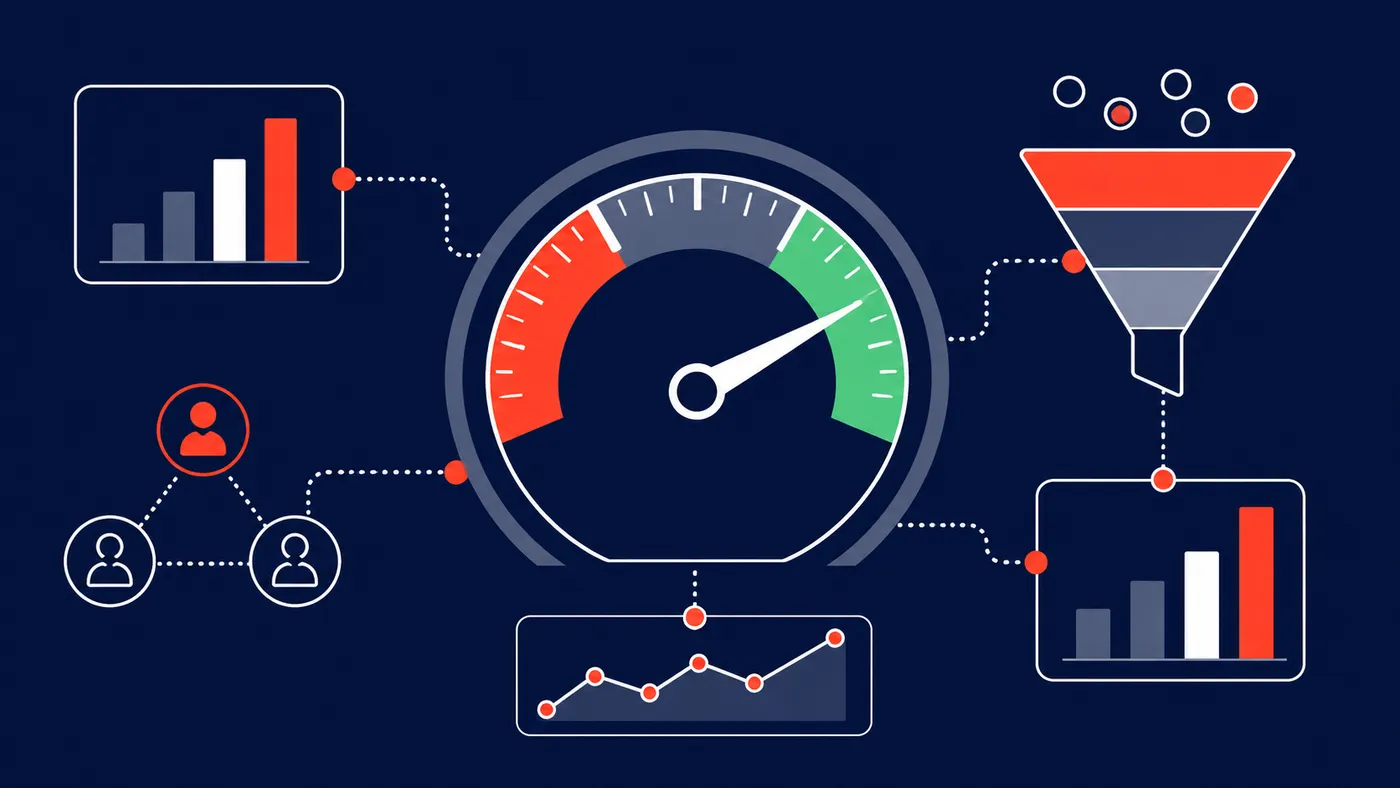
Think of it like a speedometer
When you’re driving and you glance at the speedometer, you don’t have to think. You’re over the limit: ease off. You’re under: press down. The decision is already made. You just act.
A good measurement marketing dashboard works the same way. You open it, you see the numbers, and you already know what they mean and what you do next. You’re not digging through data trying to figure out if something is good or bad. You built the system so that question already has an answer.
Two things worth your attention that most people skip
First: your landing page
You’re spending money to get a click. Most people assume the page takes care of the rest. Most of the time, they’re wrong and they don’t know it. You can actually see where people stop reading, how far they scroll, whether they’re even reaching your call to action. If people aren’t getting to the CTA, that’s a page problem. More ad spend makes it worse, not better.
Second: what “conversion” actually means on each platform
A conversion on Facebook is not the same thing as a conversion on Google Ads. They measure differently. When you compare the two numbers directly, you’re not comparing results. You’re comparing different definitions of the same word. A measurement marketing system removes that confusion, because you’re the one setting the definition.
Where most businesses actually are right now
I think of measurement in terms of altitude.
At the bottom, you’re in the cave. You’re asking basic questions: How many people visited this page? How many saw the call to action? How many clicked it? These sound simple. Most businesses can’t answer them cleanly.
Higher up, the questions get better: What’s the lifetime value of a customer who used a coupon on their first purchase versus one who didn’t? What’s my marketing efficiency by segment? But you can only ask those questions if you’ve got solid data underneath them. You can’t get there from the cave.
Most businesses are still in the cave. They’ve turned on Google Analytics, but they haven’t set it up to actually measure anything. The numbers are coming in; they’re just not answering any real question. The first job is building the structure so they do.
If you want to start today
Two things, in order.
- Set up conversion tracking. Decide exactly what counts as a lead or a sale, and make sure your system is recording it consistently — not differently on each channel.
- Set up UTM parameters. These are tags you attach to your ad URLs that tell Google Analytics where the traffic came from. Without them, a large chunk of your traffic shows up as “direct” and you lose the thread completely.
That’s the foundation. From there you can build. If you want to learn it yourself, MeasureU has solid training on getting this right. If you’d rather hand it off, hire someone who starts with your questions and works backwards — not someone who installs a tool and hands you a dashboard you don’t understand.
Before you do anything else, ask yourself two questions.
Do you trust your data?
Is your data telling you a story?
If the answer to either is no, that’s where to start. Fix the measurement before you try to fix the marketing. The businesses that get this right see 15 to 30 percent growth year over year — not because they found a magic channel, but because they stopped making decisions based on data they couldn’t trust.
Frequently Asked Questions
What's the difference between marketing measurement and measurement marketing?
Marketing measurement means running ads and then checking what the platforms report. Measurement marketing means building your tracking system first, agreeing on what you're measuring and what you'll do about it, and then running the ads. The order matters because it determines whether you're chasing data or acting on it.
What is marketing attribution?
Attribution is the process of crediting the right marketing activity for a conversion. If someone saw your Facebook ad on Monday and clicked your Google ad on Friday before buying, which one gets credit? Attribution answers that. Most platforms claim full credit for any conversion that happened within their window, which is why you need a single measurement system instead of trusting each platform's numbers.
What tools do I need to measure my marketing?
For most small and mid-sized businesses, three tools cover it. Google Tag Manager captures the data from your site and ads. Google Analytics stores it and makes it queryable. Data Studio displays it in a dashboard you can actually use. None of them require a developer to set up, but they do need to be configured properly — installed does not mean working.
What is a UTM parameter?
A UTM parameter is a tag you add to the end of a URL that tells Google Analytics where the traffic came from. If you're running a Facebook ad, you add a UTM tag to the link so that when someone clicks it, GA records it as Facebook traffic rather than direct. Without UTMs, you lose the thread on where your visitors are coming from.
What's the difference between Google Tag Manager, Google Analytics, and Data Studio?
They each do one job. Google Tag Manager tracks user behaviours on your site — page views, button clicks, form submissions, scroll depth. Google Analytics receives that data and stores it. Data Studio is where you build the dashboard that makes it readable and actionable. You need all three. GTM without the others means you're collecting data nobody can see. GA alone gives you reports that are hard to turn into decisions. Data Studio is what makes the whole system usable.
